


HALIFAX, NOVA SCOTIA | CANADA B3H 4R2 | +1 (902) 494-2211

Dalhousie Institute on
Society & Culture

MacKay Lectures


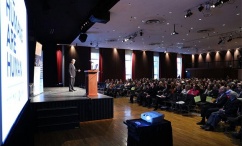
The annual MacKay Lecture Series features four lectures given by internationally renowned speakers, addressing subjects related to the liberal and performing arts. Three of the lectures revolve around a common interdisciplinary theme chosen each year by the Faculty Research Development Committee. The one remaining lecture is on a broadly based historical theme, in recognition of the generous donation funding the lecture series, given by Gladys MacKay in appreciation of the education that her husband, the Reverend Malcolm Ross MacKay received at Dalhousie as a B.A. student in History (1927). 


2011-2012 MacKay Lecture Series


Reconciliation:  The Responsibility for Shared Futures


Brian Noble, supported by Sociology and Social Anthropology, Canadian Studies, and International Development Studies // bnoble@dal.ca, 902-494-6751


Three internationally-distinguished Canadian scholars have agreed to deliver the 2011-2012 MacKay Lectures -- all have offered some of the most powerful humanities and social science scholarship, anywhere, in relation to this thematic:  Anishinabek/Ojibway Legal Scholar Dr. John Borrows (Robina Chair in Law, Public Policy and Society, U. Minnesota); Political Philosopher Dr. James Tully (Distinguished Professor of Political Science, Law, Indigenous Governance and Philosophy at the U. of Victoria); and Anthropologist Dr. Michael Asch (Professor emeritus, U. of Alberta, Hon. Doctorate Memorial U.). 


Thursday, March 8 -- Canadian Anthropologist Michael Asch, FRSC, has worked untiringly on the issue of finding just resolution of relations between Aboriginal Peoples and Canada. Dr. Asch will speak on some of the powerful arguments in his forthcoming book We are all Here to Stay: Between Canadian Sovereignty and First Nations’ Self-Determination (University of Toronto). In his new book he unpacks the history of legal, political, and knowledge relations between newcomers to Canada and Indigenous Peoples, and offers an empirically-sound proposition for the reconciliation of relations between Indigenous and non-Indigenous peoples, following a path that “offers an opportunity for Canadians to come to terms, honourably, with our settlement in what we used to call the New World.”  Dr. Asch argues that his proposition is grounded in a common capacity and common will to enter into committed peaceful political relations in shared lands — by way of deeply rigorous enactment of treaty as a practice of living reciprocal obligations among peoples. His discussion goes directly to the idea of mutual responsibility in reconciliation, and expanding relations around that principle into the future.


Dr. Asch worked with the Northern Dene over the 1970s and 80s, aiding them in treaty-based land claims when they were facing the prospect of Alaskan Pipeline development through their territories, and in the 1990s was Senior Research Associate for the Royal Commission on Aboriginal Peoples.  He is recipient of the Canadian Anthropology Society’s Weaver-Tremblay Prize in Applied Anthropology and an Honorary Doctorate from Memorial University; author of the landmark book Home and Native Land: Aboriginal Rights and the Canadian Constitution (1984) among other books, as well as many articles and chapters on the history of Anthropological, Legal, and Political thought and their effects for Indigenous peoples relations with Canada.


Thursday, March 15 -- Professor John Borrows (Kegedonce) who works and writes between and across humanist and Indigenous knowledge-practices. He is one of Canada’s most highly regarded Constitutional Law experts, and much more.  Dr. Borrows’ writing, scholarship, and speaking is a living conversation between the oral history, story, pictographic, and dreaming practices of the Anishnabek, and the practices of western academic scholarship, from constitutional and case law analysis, discourse studies, to philosophical reflection.  In many ways, his scholarship is an enactment, a “physical philosophy” of Indigenous peoples’ reconciliation of their legal traditions, with those of Canada, and in turn with Creation.  Dr. Borrows’ lecture will open audiences to this practice of reconciliation, as exampled in his 2010 paired volumes Drawing out the Law:  A Spirit’s Guide, and Canada’s Indigenous Constitution. It is precisely his gentle, yet formidable capacity to move between an Indigenous practice of knowledge and a conventional scholarly one, that gives Dr. Borrows the quiet authority to draw us all into the unfolding livable possibilities of reconciliation between peoples, with the animated things of nature, with the richness of our differences.


Dr. Borrows is Anishinabek / Ojibway and a member of the Chippewa of the Nawash First Nation in Ontario.  Author of numerous articles and books, his Recovering Canada; The Resurgence of Indigenous Law, received the Donald Smiley Award for the best book in Canadian Political Science. Professor Borrows is a recipient an Aboriginal Achievement Award in Law and Justice as well as innumerable gifts of honour from Indigenous communities in Canada and around the world, a Fellow of the Trudeau Foundation, and a Fellow of the Academy of Arts, Humanities and Sciences of Canada.


Thursday, March 22 -- The third and final speaker is one of this year’s national Killam Prize winners, Professor James Tully, Distinguished Professor of Political Science, Law, Indigenous Governance and Philosophy at the U. of Victoria. Dr. Tully will speak on “Reconciliation as being-peace” both in relations between peoples, and in relations with the common earth on which we live and strive to flourish together.  Prof. Tully has suggested provisionally that he will set out a number of different ways in which ‘reconciliation’ has been understood and then make a series of arguments for one particular understanding, as the best way forward in the next decade. His approach is to seek a double move in reconciliation — the first move being reconciliation between peoples for past wrongs done, and the second, necessarily related move being a non-violent reconciliation of our modes of living with the earth, both Indigenous and non-Indigenous.  The latter, shared responsibility answers an imperative of our contemporary condition, embracing a positive mutual way forward, beyond redress of past harms.

Professor Tully is among the most influential political philosophers in Canada and beyond, author or editor of eight books and many articles in the field of contemporary political and legal philosophy and its history, and in Canadian political and legal philosophy.  He was also a Senior advisor to the Royal Commission on Aboriginal Peoples. In 2010, he was awarded the prestigious Killam prize in recognition of his distinguished career and exceptional contributions to Canadian social science scholarship and public life.  His monographs include the two-volume Public Philosophy in a New Key (Cambridge, 2008), Strange Multiplicity: Constitutionalism in the Age of Diversity (Cambridge, 1995), and A Discourse on Property: John Locke and his Adversaries (Cambridge, 1980).


2010-2011: Global Change and the Need for a New Social Imagination

          2009-10 - Sustainability: Past, Present, Future

2008-09 - Music, Culture, and Society

2007-08 - Identities and Ideologies:  Changes and Transformations in the Modern Islamic World

2006-07 - The Early Modern Family

2005-06 - With Respect to Readers: Book History and the History of Reading

2004-05 - Finding the Balance: Citizenship, Immigration, and Security

2003-04 - Europe: A Multidisciplinary Feast

2002-03 - Origins

2001-02 - Cross-Cultural Exchanges in North America


Call for Proposals for 2011-2012 MacKay Lecture Series 

For more information contact the Dean’s Office, Faculty of Arts and Social Sciences, Dalhousie University, 494-1440.